Rewriting Rust’s Borrow Checker in SQL
1,417 wordsCode Link
Many beginners are intimidated by Rust’s borrow checker. It’s a unique tool that prevents unsafe reference access and gives Rust strict compile-time safety. At first, the errors it outputs can seem obscure and unintuitive. However, most people don’t realize that the central mechanism can be implemented with a couple of SQL queries!
The History of Borrow Checking
The golden rule is that you can either have one mutable reference or any number of immutable references. But how does Rust know whether you’re borrowing correctly?
There have been three major approaches to borrow checking in Rust: Lexical Lifetimes, Non-Lexical Lifetimes (NLL), and Polonius.
In early versions of Rust, references were considered alive until they went out of scope. The borrow checker could therefore look at the range of lines where a reference was in scope and ensure that the golden rule was followed. This is called a lexical lifetime because it uses the lexical scope of the variable to determine when the borrow ends.
However, this approach is overly conservative. What if I have a reference in scope but only use it twice? Should its borrow persist for the entire scope?
Non-Lexical Lifetimes (NLL) take a more intelligent approach by determining when a reference is used for the last time. Instead of tying a borrow to the enclosing scope, NLL ends the borrow after its final use. This makes borrow checking much more granular and allows the compiler to accept many more valid programs.
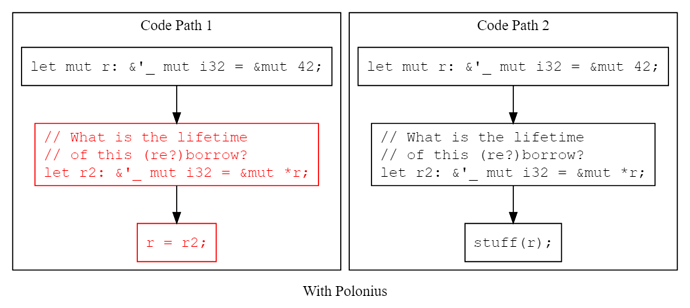
However, NLL is still conservative in some cases because it can’t precisely reason about every possible control-flow path. Here is an example of a program that NLL rejects even though it is safe. As humans, it’s clear that either the if branch executes and returns, or the code afterwards executes—but never both.
use std::collections::HashMap;use std::hash::Hash;
fn get_or_insert_default<'a, K, V>( map: &'a mut HashMap<K, V>, key: K,) -> &'a mut Vwhere K: Hash + Eq + Copy, V: Default,{ if let Some(value) = map.get_mut(&key) { return value; }
map.insert(key, V::default()); map.get_mut(&key).unwrap()}Polonius
More recently, the Rust community has been developing a new borrow checker called Polonius.
The original Polonius model expressed borrow checking as Datalog rules evaluated using Datafrog. Datafrog is a logic engine that derives facts from a set of core premises.
Rustc first lowers the source into MIR (Mid-level Intermediate Representation), where the function is represented as basic blocks connected by control-flow edges. The borrow checker then extracts facts from that MIR. From these facts, it repeatedly derives new facts until it reaches a fixed point, at which no additional information can be inferred.
Because facts are structured statements and recursive derivations are just joins between structured statements, you can think of this control-flow analysis as a set of recursive joins—similar to those in a SQL database. We’ll be implementing a toy borrow checker inspired by this style of analysis.
Implementing Borrow Checking in SQL
We can start by defining some core primitives. We can represent every fact about a program as a row in a table. Relations are sets of facts generated from a program. Rules are inference statements used to derive facts from other facts.
A Toy Example
Consider an implication(source, target) relation. We will write the fact implication(A, B) as A => B. A rule can be: If A => B and B => C, then A => C for all A, B, C. Thus, through recursively applying this rule, we can trivially prove that A => D for the following pseudocode.
A => BB => CC => DOne way to express this in SQL would be to use a self-join on an implication table with the following query:
SELECT first.source, second.targetFROM implication AS firstJOIN implication AS second ON first.target = second.source;We can take these results and insert them back into the implication table, which stores all the facts we know about a program. We can loop this until we can no longer derive facts. The code for inserting in this example is shown below:
INSERT INTO implication (source, target)SELECT first.source, second.targetFROM implication AS firstJOIN implication AS second ON first.target = second.sourceON CONFLICT DO NOTHING;As mysterious as a borrow checker may seem, its behavior can be attributed to this loop.
A More Concrete Example
Consider the short block of Rust code with a clearly illegal reference access:
fn main() { let mut value = 0; let borrowed = &value; value = 1; println!("{borrowed}");}We can define cfg_edge(source, target) as a relation that says control may move directly from one MIR point to another. In this example the graph is a straight line, but branches produce multiple outgoing edges.
We can also define loan_live_at as a relation that says that if a reference (we will call it a loan) is live at P1 and cfg_edge(P1, P2), then the loan may also be live at P2 (depending on what is required at P2).
Now we can check variable liveness—how long a variable lives in a program. These are propagated backward. We read the println!(...) statement and infer that borrowed must have existed at every preceding point until we reach its definition.
On the line where the loan is issued for borrowed (we’ll refer to the loan as bw0), we can say that the loan must also be live for that same lifetime. While the shared loan is live, the borrowed value cannot be mutated through a competing access path. Therefore, assigning to value produces a loan_invalidated_at fact. Finally, we can define a rule that if a loan is both alive and invalidated, then there is an unsafe access and prove that this access is unsafe.
Let’s say we swapped the assignment and the final use. The program below would be valid because L3 is the final use of borrowed, so backward liveness does not make it live at L4. The mutation therefore occurs after the loan has ended.
fn main() { let mut value = 0; let borrowed = &value; println!("{borrowed}"); value = 1;}Expressing the Basic Rules
We can express some basic rules in SQL from these explorations.
Rule 1: A used variable is live
If a variable is used at a point, then it must be live when execution reaches that point.
IF var_used_at(V, P)=>var_live_on_entry(V, P)This can be expressed in SQL as:
INSERT INTO var_live_on_entry (variable, point)SELECT variable, pointFROM var_used_atON CONFLICT DO NOTHING;Rule 2: Propagate liveness backward
If a variable is live at P2, and control moves from P1 to P2, then the variable must also be live at P1. However, propagation stops if the variable is defined at P1.
IF var_live_on_entry(V, P2)AND cfg_edge(P1, P2)AND NOT var_defined_at(V, P1)=>var_live_on_entry(V, P1)This can be expressed in SQL as:
INSERT INTO var_live_on_entry (variable, point)SELECT live.variable, edge.sourceFROM var_live_on_entry AS liveJOIN cfg_edge AS edge ON edge.target = live.pointWHERE NOT EXISTS ( SELECT 1 FROM var_defined_at AS defined WHERE defined.variable = live.variable AND defined.point = edge.source)ON CONFLICT DO NOTHING;Rule 3: Introduce loan_required_at as a toy bridge
Note:
loan_required_atis made up for this post to keep the rule compact. A real checker derives the equivalent “still needed here” information from liveness plus origin/loan relationships, rather than treating it as an input fact.
Rule 4: Propagate a required loan forward
If a loan is live at one point, control can move to another point, and the loan is still required there, then it is live at the next point.
IF loan_live_at(L, P1)AND cfg_edge(P1, P2)AND loan_required_at(L, P2)=>loan_live_at(L, P2)This can be expressed in SQL as:
INSERT INTO loan_live_at (loan, point)SELECT live.loan, edge.targetFROM loan_live_at AS liveJOIN cfg_edge AS edge ON edge.source = live.pointJOIN loan_required_at AS required ON required.loan = live.loan AND required.point = edge.targetON CONFLICT DO NOTHING;Rule 5: Detect an invalidated live loan
If a loan is live and invalidated at the same point, then the program contains an unsafe access.
IF loan_live_at(L, P)AND loan_invalidated_at(P, L)=>error(L, P)This can be expressed in SQL as:
INSERT INTO errors (loan, point)SELECT live.loan, live.pointFROM loan_live_at AS liveJOIN loan_invalidated_at AS invalidated ON invalidated.loan = live.loan AND invalidated.point = live.pointON CONFLICT DO NOTHING;These rules are not a complete representation of the borrow checker, but they demonstrate the analysis it performs.
Implementation
A simple implementation is included in this repository for you to follow along with. Rust’s borrow checker does not run on the source code directly, but rather on the mid-level intermediate representation. At this level, all conditionals are decomposed into “basic blocks,” which are sets of continuous instructions ending in a branch, jump, or return. Variable names are replaced with placeholders, and the representation uses cryptic internal names for primitives that are outside the scope of this blog.
The important thing to know is that we can get a list of the facts (rows in our relations) by running the following command:
rustup run nightly rustc \ -Z nll-facts \ -Z nll-facts-dir=fixtures/borrow_conflict \ -Z dump-mir=nll \ -Z dump-mir-dir=fixtures/borrow_conflict/mir \ fixtures/source/borrow_conflict.rsNote that the default Rust compiler does not support this and you must be running the nightly toolchain. This command produces two outputs. -Z nll-facts emits the relation files that Laertes loads into PostgreSQL. -Z dump-mir emits a human-readable MIR representation that helps us understand where those facts came from. Example outputs are in /fixtures/.
We can start by defining structs for rules and relations.
#[derive(Debug, Clone, PartialEq, Eq)]pub struct Relation { pub name: &'static str, // Generic to allow us to represent // Edge(source, target) // LoanIssuedAt(origin, loan, point) // LoanKilledAt(loan, point) pub columns: &'static [&'static str],}
#[derive(Debug, Clone, PartialEq, Eq)]pub struct Rule { pub name: &'static str, pub target: &'static str, pub select: &'static str,}We can write all of our rules in SQL. These can be found in the /src/rules/ directory.
Then we can write a core loop to apply these rules to facts output by the MIR dump. If we are left with errors in the errors table, then we have violated a borrow-checking rule. This loop applies rules, derives facts, ignores duplicate facts, and stops when no additional facts can be derived.
pub fn run_to_fixed_point( client: &mut Client, rules: &[Rule],) -> Result<Evaluation> { let mut rounds = 0; let mut facts_derived = 0;
loop { let mut facts_derived_this_round = 0;
for rule in rules { facts_derived_this_round += rule.apply(client)?; }
if facts_derived_this_round == 0 { return Ok(Evaluation { rounds, facts_derived, }); }
rounds += 1; facts_derived += facts_derived_this_round; }}These are the core pieces needed to implement a borrow checker. I would encourage you to read the source code for yourself and see how things are threaded together.
Conclusion
Rust’s borrow checker often feels opaque, but it is much simpler at its core. Datalog uses a much more efficient implementation of this strategy (semi-naive evaluation), but the core principle is the same. Large programs can generate many facts and recursive joins, and PostgreSQL is not the right execution engine for a production compiler.
Nevertheless, it’s an effective way to break down the borrow checker into simple rules to reason through when writing code.